image
 

The Living Planet Program : Soil Moisture and Ocean Salinity (SMOS)

have a look at the SMOS Blog:
the news of the CESBIO SMOS team


image

For any questions or
comments on this mission, please contact :
Yann Kerr at CESBIO

© Copyright 2009 CESBIO, 
Tous droits réservés

SMOS Calibration and Validation.

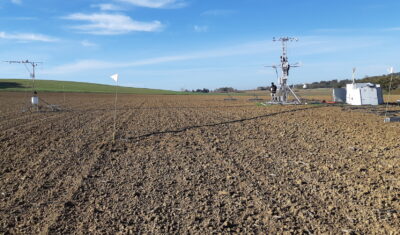
Intensive fieldwork carried out by large ground teams provided in situ information on surface temperature and detailed characterisation of the surface cover during the operation of ground-based and airborne instruments operating at the same frequency as SMOS.

The CESBIO team is involved in the CALVAL experiments described below :

  • CanEx-SM10 (Canadian Experiment for Soil Moisture in 2010)  CANEX field campaign
  • AACESS (Australian Airborne Cal/Val Experiments for SMOS)  
  • CAL-VAL CAROLS 2010 (Cooperative airborne radiometer for ocean and land studies)
  • Cal-val SMOS-MALI / NIGER
  • Calibration of SMOS products Geolocalisation Biases
  • Valencia Anchor Station (VAS) - Université de Valence
  • Soil Climate Analysis Network (SCAN) USA


CAL-VAL CAROLS 2010 (Cooperative airborne radiometer for ocean and land studies)
P.I. Mehrez Zribi(CESBIO/IRD), Project Management: Pascal Fanise (CESBIO/IRD)


The CAROLS “Cooperative Airborne Radiometer for Ocean and Land Studies” L-Band radiometric instrument has been built and tested in the context of the SMOS mission. The receiver was developed as a copy of the EMIRADII radiometer, in collaboration between the TUD (Technical University of Denmark), the LATMOS laboratory (Laboratoire Atmosphères, Milieux, Observations Spatiales) and DT-INSU.

The CAROLS radiometer has been validated and qualified with laboratory measurements, showing in particular excellent stability and resolution. The measurements demonstrated that this radiometer has a sensitivity of 0.1 K for a 1 s integration time, and a relative stability of 0.1 K over a period of 30 min.

Three campaigns were carried out before SMOS CAL/VAL campaigns in 2010. The first four flights made in September 2007 allowed CAROLS, installed in conjunction with other airborne instruments (STORM radar, GOLD-RTR GPS receiver, an infra-red radiometer and a visible wide angle camera), to be certified for use in the French research ATR-42 aircraft.

The airborne measurements verified the good sensitivity of the CAROLS data, and its good agreement with the emissivity model during wing wags and circular movements of the aircraft. However, these initial flights allowed an imperfect isolation to be identified between the X and Y channels, and a high level of detected RFI to be identified over land surfaces.

The aim of the CAROLS’2008 campaign was to validate various modifications, allowing the imperfections observed in 2007 to be corrected. Complete isolation of the two channels has been validated. Finally, following validation of the CAROLS data recorded in 2007 and 2008, the initial objective of the 2009 CAROLS campaign was to acquire scientific data for the inversion algorithm, used to provide soil moisture and ocean salinity estimations.

After the successful launch of SMOS in November 2009, two SMOS CAL/VAL campaigns were organised over three test sites, during two periods: April-July 2010, with a total of 22 flights, and November 2010 with 4 flights.

Somme pictures from CAROLS campaigns

Partners in CAROLS campaigns: CNES, CESBIO, CNRM, ESA, IEEC, INRA, LATMOS, LOCEAN, SAFIRE, Valencia University

  • contact / CESBIO : Mehrez Zribi
  • CAROLS campaigns on INSU/CNRS website

see also the SMOS sector performed by the "LOCEAN" laboratory you can access salinity data and in situ measurements ( CAROLS campaigns) image


Cal-val SMOS-MALI / NIGER

Principal Investigator: Thierry Pellarin (Laboratoire d'étude des Transferts en Hydrologie et Environnement, LTHE), Bernard Cappelaere (Hydro Sciences, Montpellier - HSM)

Primary Application Domain: Calibration/Validation
Secondary Application Domain: Hydrology

Title : Multiscale validation of SMOS brightness temperature and products over West Africa

The aim of this project is to use both ground measurements and land surface modelling approaches to compare and validate SMOS products over West Africa in the framework of AMMA project.

more details and results image


AACESS Australian Airborne Cal/Val Experiments for SMOS

The AACESS campaign – short for Australian Airborne Calibration/Validation Experiments for SMOS – is part the SMOS Validation/Calibration activities. It has been organized by Jeff Walker, Chris Rüdiger, Sandy Peischl (University of Monash - Melbourne), with the main objectives of validating the SMOS products (brightness temperatures and soil moisture) and monitoring soil moisture.

The area of study is the Murrumbidgee River catchment covering an area of about 100 x 500 km, corresponding to 20 SMOS pixels.

The first part of the campaign took place between the 18th of January and 22th of February 2010. The campaign consists in field measurements (soil moisture, vegetation, meteorological data) and airborne measurements (L-band, Thermal InfraRed, Near InfraRed, Visible). To validate the SMOS brightness temperatures, an aircraft is equipped with the a L band instrument PLRM (Polarimetric L-band Multibeam Radiometer).

image to have a look... esa
image AACES-1 Project web site esa
image more information on the ESA site esa

contacts cesbio :


Calibration of SMOS products Geolocalisation Biases
Principal Investigator. : Francois Cabot (CESBIO/CNES)

Primary Application Domain: Calibration/Validation

The aim of this study is to deliver a full characterization of on-orbit geolocalisation biases as observables in SMOS products.

more details image


Valencia Anchor Station (VAS) - Université de Valence

P.I. : Ernesto Lopez-Baeza (Valencia University)

modelling of soil moisture and brightness temperature at Smos pixel scale
Contact CESBIO : Silvia Juglea

more details


Soil Climate Analysis Network (SCAN) USA

This soil climate analysis network is operated by the United States Department of Agriculture (National Water and Climate Center)

Comparison between SCAN site data and SMOS data for soil moisture and events of thaw and freeze
Contact CESBIO : Ahmad Albitar

more details image


PREVIOUS CAMPAIGNS ...


COSMOS (Campaign for validating the Operation of Soil Moisture and Ocean Salinity), and NAFE (National Airborne Field Experiment) were two airborne campaigns held in the Goulburn River catchment (Australia) at the end of 2005.

Cal Val SMOS Murray-Darling Basin: National Airborne ield Experiment (NAFE)
Principal Investigator : Gilles Boulet (CESBIO/IRD)

Primary Application Domain: Calibration/Validation
Secondary Application Domain: Hydrology

The aim of this proposal is to use a combination of gridded airborne L-band brightness temperature, NDVI and surface temperature data and distributed in-situ soil moisture data acquired at the scale of several SMOS pixels during two field experiments in SE Australia (NAFE) to test 1- the SMOS soil-moisture retrieval algorithms (inversion of local soil moisture from airborne brightness temperature data) 2- the SMOS disaggregation algorithms (inversion of local soil moisture from coarse brightness temperature and auxillary remote-sensing data). This proposal falls within the Cal/Val SMOS activities for which a joint proposal with the same objectives is submitted to the adhoc program at ESA, lead by our Australian partners represented by Prof. Jetse Kalma.

image more details

image website of NAFE

image ESA presentation for the CaL-Val

image Results of the (COSMOS/NAFE'05 Experiment


  site map sitemap webmaster webmastre crédit credit Copyright 2010 CESBIO, Tous droits réservé